
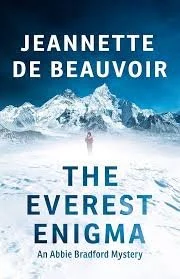
An enigma is “a person, thing, or situation that is mysterious, puzzling, or difficult to understand,” and that certainly fits climbing Mount Everest - at least in my non-climber’s mind. Of course, there are a lot of things that people seem inspired to do, like rowing single-handed across the Atlantic or being a contestant on the TV show, Survivor that I don’t understand.
But that’s not the primary enigma that Jeannette de Beauvoir is writing about in her book, The Everest Enigma. Her protagonist, Abbie Bradford, a wealthy history major and non-climber, is certainly puzzled by the motivations of the dozens of wealthy people who seem driven to get to the top of the tallest mountain in the world at 29,031.7 feet. You get there, look around, take a picture, get out of the way of all the other people wanting to stand there, and then struggle to get back down and not die.
De Beauvoir weaves a murder mystery and several love stories into her novel, which she also ties into the Silk Road - the 4,000 mile, ancient network of Eurasian trade routes active from about 130 B.C.E. Since this is historical fiction, she also follows the story of George Mallory, who ostensibly was the first man to reach the top of Everest, neatly paralleling the story of Sir Edmund Hillary, who achieved the feat. Part of the ‘enigma’ is proving whether Mallory actually made it despite dying in the effort. None of the explains what is actually going on in de Beauvoir’s story which is the story of the development of a story which Winston Churchill might have called “a riddle wrapped in a mystery inside an enigma” which he applied to the incomprehensible actions of the Soviet Union.
De Beauvoir’s writing is excellent, and I enjoyed this book. I will be interested to see what other Abbie Bradford mysteries she conjures up.