
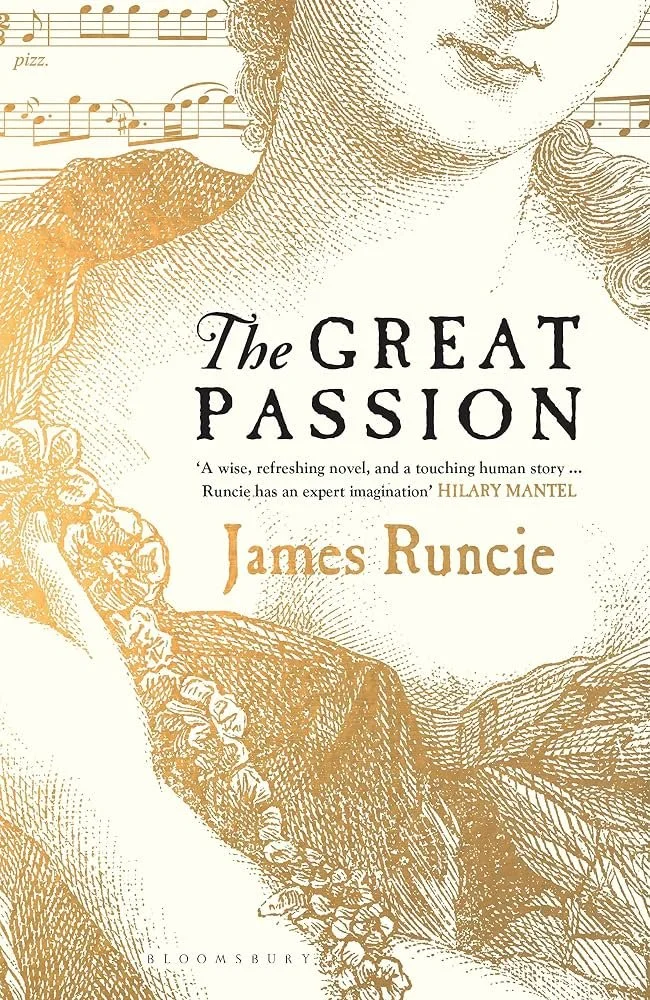
The Great Passion by James Runcie is a historical fiction novel set in the early 1700s, centered on the creation by J.S. Bach of the Passion According to St. Matthew, BWV 244, which he presented at St. Thomas’s in Leipzig. The story is told through the eyes of a red-haired young man, Stefan Silbermann, who has been sent to the school at St. Thomas’s to distract him from the pain of losing his mother to an unnamed disease. Because he has red hair, he is picked on by the other boys. He runs away, is befriended by an oboe player, and eventually returned to the cantor - J.S. Bach. Stefan also has a beautiful soprano singing voice.
Runcie portrays the musical turmoil that surrounds the many members of the Bach family, the rivalries between musicians, visits from Telemann, Silbermann’s childhood crush on Bach’s daughter, the sudden devastating death of another daughter, and the horrific execution of a thief. All of this is interspersed with religious quotations in Latin and German, as though you are reading through a symphonic score. The story gradually builds to the presentation of the Passion, which occurs at the end of young Silbermann’s school term, after which he returns home to carry on the family business of building organs, reluctantly leaving behind his mentor and the love of his life.
Passion is reflected on many levels throughout this story, which portrays Bach as a complex family man whose head is bursting with music, all of which is driven by a passion for God. It is rare to read a book where work produced by a central character can be listened to while you read, almost as though he is sitting beside you.
The German and the Latin slow the story down, but the novel is a well-written portrayal of a remarkable musical genius.