
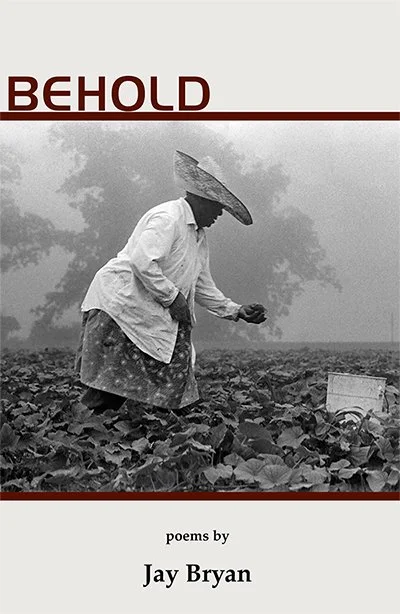
I have to start this review with two thoughts: one, Jay Bryan is a friend and classmate. And two, I don’t read a lot of poetry. In fact, over the last fifty or so years, I doubt if I’ve read more than a handful of poems, so I had to think hard reading this book. And that was a good thing.
Behold by Jay Bryan is a reflection of the poet and the world he experienced during the summers of 1973 and 1974 on farms across North Carolina and in Belle Glade, Florida. After working with, observing, and recording the thoughts and words of the migrants, he went on to being an attorney for the bulk of his working years.
The book is divided into two parts. The first part is the poems, and the second part is three appendices and an epilogue. Since it is a book of poetry and poetry can take many formats, I considered both parts poetically. And poetry often uses startling juxtapositions of words. So when the poem reads, “People need a meal a day, a place to stay, a bar of soup and clean pajamas” … was the soup a typo, a Freudian slip, or the flow of the words through Jay’s mind? The poems are beautiful, lyrical, and graphically describe the struggle and seemingly anonymous life that Jay turns the spotlight on with his words.
Then there are the prose appendices that are purported to be from tapes. Did Jay write those ‘transcripts’? Are they his ‘poetry’? They are an interesting commentary on the world he created with his poems, but should they be considered poems in another format—or something else?
Since they are a part of the book, I think they should be considered something Jay created and part of the whole. Yet, they are appendices. Commonly, appendices, dedications, and notes are not considered part of the work. But these appendices do not clarify the body of the poetry. It is not clear why Jay included them. They are background coloring, although their origins are vague and purposefully mysterious.
Because of the time this was written, when the world of a Long Island do-gooder-preppy was filled with protest and anger at the abuse of less valued humans, these poems indirectly reflect Jay’s feelings, like an image on the surface of a puddle. They made me think, and that was a good thing.